Mini Tummy Tuck vs Full Tummy Tuck – Which Is Suitable?
If you are considering a tummy tuck in Antalya, one of the first questions you may encounter is whether you need a mini tummy tuck or a full tummy tuck. Although both procedures are designed to improve the contour of the abdomen, they are not simply smaller and larger versions of exactly the same operation.
A mini tummy tuck, also known as mini abdominoplasty, generally focuses on the lower abdomen below the belly button. A full tummy tuck, or full abdominoplasty, addresses a larger area of the abdomen and may involve more extensive removal of excess skin, repositioning of the belly button and repair of separated abdominal muscles when clinically appropriate.
The correct procedure depends on your anatomy, skin laxity, muscle condition, previous pregnancies, weight changes and expectations—not simply which operation has the shorter scar or recovery period.
For international patients considering tummy tuck surgery in Antalya, Turkey, understanding these differences before travelling can make the consultation and treatment-planning process much clearer.
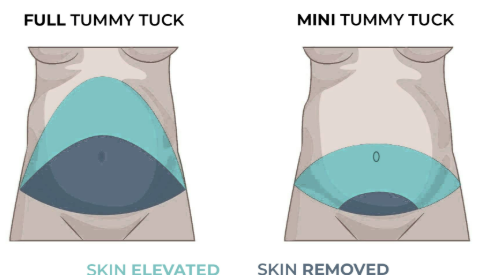
This guide compares mini and full tummy tuck surgery, including suitability, scars, muscle repair, belly button changes, recovery, liposuction and what to consider before choosing abdominal contouring surgery.
What Is a Tummy Tuck?
A tummy tuck is a surgical body-contouring procedure designed to address excess abdominal skin and, in appropriate cases, the underlying abdominal wall.
The medical term for tummy tuck surgery is abdominoplasty.
Changes to the abdominal area can develop for several reasons, including:
- Pregnancy
- Significant weight loss
- Ageing
- Genetics
- Previous surgery
- Changes in skin elasticity
Exercise can strengthen muscles and reduce body fat, but it cannot always correct loose skin or significant abdominal wall separation.
This is where abdominoplasty may be considered.
However, a tummy tuck is not primarily a weight-loss operation. Patients should generally approach surgery with realistic expectations about what abdominal contouring can and cannot achieve.
What Is a Mini Tummy Tuck?
A mini tummy tuck is a more limited form of abdominoplasty that generally focuses on the lower abdomen.
It may be considered when the main concern is a relatively small amount of loose skin located below the belly button.
Compared with full abdominoplasty, the operation usually involves a more limited area of skin removal.
In suitable cases, the belly button may not need to be repositioned.
The procedure can therefore be appropriate for a specific group of patients rather than being a universally preferable “less invasive” alternative.
A patient who has substantial skin laxity above and below the belly button will usually not obtain the same degree of correction from a mini tummy tuck as someone whose problem is confined to the lower abdomen.
What Is a Full Tummy Tuck?
A full tummy tuck addresses a larger area of the abdomen.
The procedure usually involves an incision across the lower abdomen, removal of excess skin and redraping of the remaining abdominal skin.
Because more skin is repositioned, the belly button commonly needs to be brought through a new opening while remaining attached to its underlying stalk.
When abdominal muscle separation is present and repair is appropriate, the surgeon may also tighten the abdominal wall.
A full tummy tuck is therefore generally considered when concerns extend both above and below the belly button.
Mini Tummy Tuck vs Full Tummy Tuck: The Main Difference
The key difference is the extent and location of the problem being treated.
A mini tummy tuck primarily targets the lower abdomen.
A full tummy tuck treats a broader area of abdominal skin and may address abdominal wall separation more extensively.
The decision is not based simply on how much surgery a patient wants.
For example, someone may prefer a mini tummy tuck because they want a smaller scar. But if significant loose skin extends above the belly button, limiting surgery to the lower abdomen may leave much of the original concern untreated.
Conversely, a patient with only a small lower-abdominal skin fold may not necessarily require the extent of surgery associated with a full abdominoplasty.
Clinical assessment is therefore essential.
Who May Be Suitable for a Mini Tummy Tuck?
A mini tummy tuck may be considered for patients whose concerns are predominantly located below the belly button.
Potential characteristics can include:
- Mild lower-abdominal skin laxity
- A small lower-abdominal skin fold
- Relatively good skin quality above the belly button
- Limited abdominal wall concerns
- Stable body weight
- Realistic expectations
Patients sometimes describe this concern as a small “lower belly pouch” that remains despite exercise and weight stability.
However, appearance alone is not enough to determine suitability.
The surgeon needs to assess skin mobility, abdominal wall condition, fat distribution and the location of the belly button before recommending a mini abdominoplasty.
Who May Be Suitable for a Full Tummy Tuck?
A full tummy tuck may be considered when there is more extensive abdominal skin laxity.
This is frequently seen after pregnancy or substantial weight loss.
Potential characteristics include:
- Loose skin above and below the belly button
- Significant abdominal skin excess
- Stretching following pregnancy
- Abdominal muscle separation
- A larger lower-abdominal fold
- Changes following major weight loss
The procedure allows the surgeon to address a wider area than a mini tummy tuck.
For this reason, full abdominoplasty is often discussed with patients seeking more extensive abdominal reshaping.
What Is Diastasis Recti?
Diastasis recti refers to separation or widening between the rectus abdominis muscles.
It is commonly associated with pregnancy but can occur in other circumstances.
Some patients notice that their abdomen continues to protrude despite losing weight and strengthening their core.
When clinically appropriate, abdominal wall repair can be performed as part of tummy tuck surgery.
However, not every patient has diastasis recti, and not every abdominal contour concern is caused by muscle separation.
The surgeon should examine the abdominal wall before deciding whether muscle repair is required.
Can a Mini Tummy Tuck Repair Abdominal Muscles?
Limited muscle repair may be possible in selected mini tummy tuck cases, depending on where the abdominal wall problem is located.
However, when significant muscle separation extends through a larger portion of the abdomen, a full tummy tuck may provide greater surgical access for repair.
This is one reason patients should not decide between mini and full abdominoplasty based only on photographs.
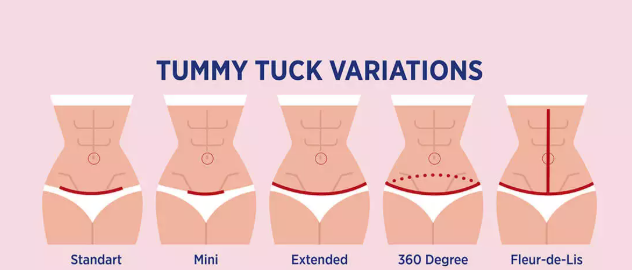
The condition underneath the skin matters as much as the visible skin excess.
Does a Mini Tummy Tuck Change the Belly Button?
One of the commonly discussed differences between mini tummy tuck and full tummy tuck surgery concerns the belly button.
In many mini tummy tuck procedures, the belly button does not require the same type of repositioning used during full abdominoplasty.
This is because the amount of skin being removed and repositioned is more limited.
However, individual techniques vary.
Patients should ask their surgeon exactly what is planned for their anatomy.
What Happens to the Belly Button During a Full Tummy Tuck?
During a standard full abdominoplasty, the surrounding abdominal skin is repositioned while the belly button remains connected to its underlying tissue.
A new opening is then created in the repositioned skin so the belly button can emerge in an appropriate location.
Belly button design is an important aesthetic component of tummy tuck surgery.
Its size, position and shape can influence how natural the final abdomen appears.
Mini Tummy Tuck Scar vs Full Tummy Tuck Scar
Both procedures involve surgical scars.
A mini tummy tuck generally uses a lower abdominal incision that may be shorter than the incision required for a full tummy tuck.
A full tummy tuck usually requires a longer horizontal incision because more skin must be removed and repositioned.
There is also typically a scar around the belly button following standard full abdominoplasty.
Scar length varies according to the amount of excess skin and the surgical plan.
The aim is generally to position the lower scar where it can be concealed by underwear or swimwear when anatomy allows.
However, patients should understand that tummy tuck scars are permanent, even though they usually change and mature over time.
Can Liposuction Be Combined With a Tummy Tuck?
Yes, liposuction may be combined with abdominoplasty in selected patients.
This combination can address two different issues.
The tummy tuck removes and repositions excess skin, while liposuction can reduce selected areas of localized subcutaneous fat.
Depending on the individual treatment plan, liposuction may be considered around areas such as the waist or flanks to improve overall body contour.
However, combining procedures changes the surgical plan and potentially the recovery and risk profile.
The surgeon must determine whether combined treatment is appropriate.
Mini Tummy Tuck vs Liposuction
A mini tummy tuck and liposuction should not be confused.
Liposuction primarily targets localized fat deposits. It does not remove substantial quantities of loose skin.
A mini tummy tuck primarily addresses lower-abdominal skin excess and may include other surgical modifications when appropriate.
If a patient has good skin elasticity but localized abdominal fat, liposuction alone may sometimes be considered.
If loose skin is the main problem, removing fat alone may not produce the desired improvement.
Some patients require a combination.
Full Tummy Tuck vs 360 Liposuction
360 liposuction generally refers to liposuction performed around multiple areas of the torso.
It can improve body contour by reducing selected fat deposits, but it does not replace the skin-removal component of a tummy tuck.
A patient with significant loose abdominal skin may therefore still require abdominoplasty even if liposuction is performed.
Treatment planning should distinguish between excess fat, excess skin and abdominal wall laxity.
These are different anatomical concerns and may require different solutions.
Tummy Tuck After Pregnancy
Pregnancy can significantly change the abdominal wall and skin.
Some women develop loose skin, stretch marks, abdominal muscle separation and changes in fat distribution.
For patients who have completed pregnancy and are considering abdominal contouring, the extent of these changes helps determine whether mini or full abdominoplasty may be appropriate.
If loose skin is limited to the lower abdomen, a mini tummy tuck might be discussed.
When laxity extends throughout the abdomen or significant muscle separation is present, a full tummy tuck may be considered.
Future pregnancy can alter the surgical result, so future family plans should be discussed during consultation.
Tummy Tuck After Weight Loss
Significant weight loss can leave excess skin across the abdomen.
The amount and distribution vary considerably between patients.
When substantial skin excess extends across the entire abdomen, a mini tummy tuck is unlikely to address all areas.
A full tummy tuck—or in some cases another form of body-contouring surgery—may be more appropriate.
Patients who have undergone major weight loss require individualized assessment because skin excess can extend beyond the front of the abdomen to the sides and back.
How Long Does Tummy Tuck Surgery Take?
Operating time depends on the procedure and whether additional surgery is being performed.
A mini tummy tuck is generally more limited than a full abdominoplasty, while a full tummy tuck with muscle repair and liposuction can be a more extensive operation.
Surgery time should not be used as the primary factor when selecting a procedure.
The objective is to perform the operation appropriate for the patient’s anatomy while maintaining appropriate surgical planning and safety.
Recovery After a Mini Tummy Tuck
Because a mini tummy tuck usually involves less extensive tissue repositioning, recovery may be different from a full abdominoplasty.
However, it is still surgery.
Patients may experience swelling, tightness, bruising and discomfort during the early recovery period.
Activity restrictions and wound-care instructions must be followed carefully.
The exact recovery timeline depends on the operation performed and the individual patient’s healing.
Recovery After a Full Tummy Tuck
Recovery following full abdominoplasty can require more time because the procedure is more extensive.
Patients may initially experience tightness and may need to walk slightly bent forward according to their surgeon’s instructions.
Gradual walking is often an important part of postoperative recovery, but strenuous exercise and heavy lifting are restricted until medically appropriate.
Compression garments may also be recommended depending on the surgeon’s protocol.
Patients should follow their own postoperative plan rather than assuming another patient’s recovery timeline will apply to them.
How Long Should You Stay in Antalya After a Tummy Tuck?
International patients considering a tummy tuck in Antalya should plan enough time in Turkey for early postoperative care.
Unlike a minor cosmetic treatment, abdominoplasty should not be scheduled immediately before a return flight.
The appropriate stay depends on the procedure, recovery and surgeon’s protocol.
Patients should discuss their intended arrival and departure dates before booking flights.
The treatment team can then advise whether the travel schedule provides adequate time for postoperative reviews.
Can You Have a Tummy Tuck While on Holiday in Antalya?
It is possible to combine surgery with a trip to Antalya, but the postoperative period should not be treated as a normal beach holiday.
Swimming, sunbathing, strenuous sightseeing, gym activities and water sports will generally be restricted during early recovery.
If you want to enjoy Antalya before surgery, it may be more practical to schedule holiday activities before the operation and reserve the postoperative period for recovery.
Your surgeon’s advice should determine the final itinerary.
Mini Tummy Tuck vs Full Tummy Tuck: Which Is Suitable?
There is no single procedure that is better for everyone.
A mini tummy tuck may be considered when:
- Loose skin is mainly below the belly button
- Skin above the belly button remains relatively firm
- Abdominal wall concerns are limited
- Only a modest amount of skin needs to be removed
A full tummy tuck may be considered when:
- Loose skin extends above and below the belly button
- There is substantial skin excess
- Pregnancy or major weight loss has significantly changed the abdomen
- More extensive abdominal wall repair is required
- A broader abdominal contour correction is planned
The appropriate operation can only be determined after individual assessment.
Planning Tummy Tuck Surgery in Antalya
If you are travelling internationally for abdominoplasty in Antalya, Turkey, an initial remote assessment may help determine which procedure could potenti