Hair Transplant Recovery Timeline in Antalya: Day-by-Day Healing Guide for International Patients
Planning a hair transplant in Turkey is exciting, but most international patients ask the same question before booking:
“How long is the recovery process after a hair transplant?”
Understanding the hair transplant recovery timeline is essential before traveling to Antalya for a procedure. Whether you choose Sapphire FUE, DHI, or standard FUE hair transplantation, the healing process directly affects your final results.
At Tesla Travel – Micro FUE Turkey in Antalya, international patients receive structured aftercare, doctor-supervised procedures, VIP transfers, and hotel accommodation designed specifically for medical tourism recovery.
This detailed guide explains exactly what happens after a hair transplant in Antalya — day by day, week by week, and month by month.
Why Antalya Is Ideal for Hair Transplant Recovery
Antalya is not only one of Turkey’s top medical tourism destinations but also one of the most comfortable cities for post-operative recovery.
Patients prefer Antalya because of:
- Warm Mediterranean climate
- Relaxed holiday atmosphere
- Luxury hotels with private recovery comfort
- Direct international flights
- Affordable all-inclusive packages
- Experienced hair transplant teams
- Easy access to aftercare support
Unlike crowded metropolitan environments, Antalya allows patients to recover in a calmer and more relaxing setting.
Many international visitors combine their hair transplant procedure with a short holiday experience.
The First 24 Hours After Hair Transplant
Immediately after the procedure, your scalp will feel tight and slightly numb due to local anesthesia.
This is completely normal.
During the first evening after surgery:
- Tiny red implantation sites will be visible
- Mild swelling may begin
- The donor area can feel sensitive
- Small crusts will form around grafts
Patients are advised to:
- Sleep with their head elevated
- Avoid touching grafts
- Avoid smoking and alcohol
- Drink plenty of water
- Follow medication instructions carefully
At Tesla Travel – Micro FUE Turkey, patients receive:
- Medical aftercare kits
- Shampoo and lotion
- Neck pillow
- Written instructions
- Direct WhatsApp support
Most patients spend the first evening resting at their hotel.
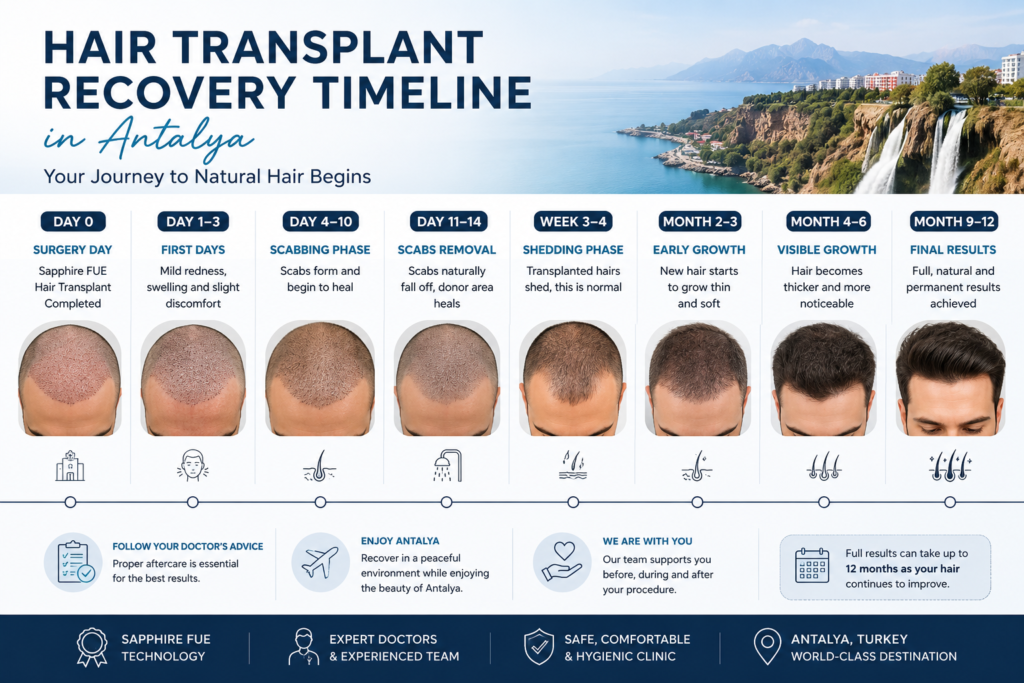
Day 2–3: Swelling and Early Healing
The second and third days are usually the most sensitive part of recovery.
Some patients experience:
- Forehead swelling
- Tightness around the scalp
- Mild itching
- Slight redness
Swelling often moves downward from the scalp toward the forehead due to gravity.
This stage is temporary and usually disappears within 3–5 days.
Important Recovery Rules During This Stage
Do NOT:
- Scratch the scalp
- Touch grafts
- Wear tight hats
- Exercise heavily
- Swim
- Expose the scalp to direct sun
You CAN:
- Walk lightly
- Relax at your hotel
- Eat normally
- Use prescribed medication
Most international patients feel comfortable enough to explore Antalya lightly after the third day.
First Hair Wash After Hair Transplant
The first wash is one of the most important parts of the recovery process.
Usually performed on Day 2 or Day 3, this wash removes dried blood and begins softening scabs safely.
At our Antalya clinic:
- The first wash is performed professionally
- Patients are taught how to continue washing at home
- Special lotions and shampoos are provided
Improper washing can damage grafts during the early healing period.
This is why professional aftercare matters significantly.
Day 4–7: Scab Formation and Visible Healing
By the first week:
- Swelling usually disappears
- Redness starts decreasing
- Scabs become more visible
- The donor area heals rapidly
Most patients are surprised by how quickly the donor area improves after modern Sapphire FUE and DHI techniques.
During this stage:
- Sleeping becomes easier
- Daily movement feels normal
- Pain is minimal or nonexistent
Can You Travel After Hair Transplant?
Yes.
Most international patients safely fly home within:
- 2–4 days after surgery
Antalya International Airport offers convenient return travel for European, Middle Eastern, and UK patients.
Day 7–14: Scabs Begin Falling Off
This is one of the most satisfying stages of recovery.
The scalp begins looking cleaner and more natural.
During this period:
- Scabs gradually fall away
- Redness continues fading
- Implanted hairs become visible
- Donor area looks significantly better
Patients must continue washing gently.
Never forcefully remove scabs.
Healthy scab removal happens naturally through daily washing and hydration.
By Day 10–14:
- Most patients can return to office work comfortably
- Visible signs of surgery become minimal
- Many people resume normal social activities
Shock Loss: Why Transplanted Hair Falls Out
Around Weeks 2–6, patients experience something called “shock loss.”
This often causes unnecessary panic.
Shock loss means:
- Implanted hairs temporarily shed
- Hair follicles remain alive underneath the skin
This is a completely normal biological process.
The transplanted follicles enter a temporary resting phase before new growth begins.
Almost every successful hair transplant patient experiences this stage.
Month 1–2: The Quiet Phase
During the first two months:
- Most transplanted hairs shed
- The scalp appears similar to pre-surgery condition
- Some redness may remain in sensitive skin types
This stage requires patience.
The follicles are establishing blood supply underneath the skin.
Although visible changes are limited, healing internally continues actively.
Common Questions During Month 1
Is it normal if hairs fall out?
Yes. This is expected.
Can grafts still fall out?
No. By this stage, grafts are securely anchored.
Can I wear a hat?
Usually yes after around 10–14 days, depending on healing.
Can I exercise?
Light exercise typically resumes after 2 weeks. Heavy gym activity usually after 4 weeks.
Month 3–4: New Hair Growth Begins
This is where excitement returns.
Most patients begin seeing:
- Small new hairs emerging
- Improved density in hairline areas
- Visible changes in photos
Hair initially appears:
- Thin
- Soft
- Uneven
This is completely normal.
The new hair gradually thickens over time.
At Tesla Travel – Micro FUE Turkey, follow-up support continues throughout this stage with online progress evaluations.
Month 5–6: Major Visible Improvement
Between months five and six:
- Density increases significantly
- Hair texture improves
- Styling becomes easier
- Hairline appears more defined
This is when most patients begin receiving compliments from friends and family.
For many men, confidence improves dramatically during this stage.
Patients often report:
- Improved self-esteem
- Better appearance in photographs
- Increased confidence in professional and social settings
Month 7–9: Hair Thickening Phase
At this stage:
- Hair shafts become thicker
- Weak follicles mature
- Density improves further
- Crown areas begin catching up
Crown recovery often develops slower than frontal hairline areas because blood circulation differs in that region.
Patients should remain patient and consistent with aftercare recommendations.
Month 10–12: Final Hair Transplant Results
Full results are typically visible between:
- 10 and 12 months
At this stage:
- Hair grows naturally
- Density stabilizes
- Hair can be cut, styled, and treated normally
- Final shape becomes fully visible
Most successful hair transplant transformations are evaluated after the one-year mark.
DHI vs Sapphire FUE Recovery Differences
DHI Recovery
DHI recovery is often:
- Slightly faster
- Less traumatic to the scalp
- Ideal for dense hairline work
DHI is particularly suitable for:
- Smaller sessions
- Hairline refinement
- Patients wanting maximum precision
Sapphire FUE Recovery
Sapphire FUE offers:
- Faster channel healing
- Reduced tissue trauma
- Better density potential
The sapphire blade technology creates finer incisions compared to traditional steel tools.
Both techniques provide excellent recovery outcomes when performed by experienced teams.
What Helps Hair Transplant Recovery?
Several factors improve healing speed and final results.
Proper Sleep Position
Sleeping elevated during the first week reduces swelling.
Hydration
Water intake supports circulation and tissue healing.
Nutrition
Protein-rich diets help follicle recovery.
Avoid Smoking
Smoking reduces oxygen delivery to grafts and negatively affects survival rates.
Follow Aftercare Instructions
Patients who carefully follow washing and medication instructions generally achieve better outcomes.
Common Mistakes After Hair Transplant
Avoiding these mistakes is critical.
Touching the Grafts
New grafts are delicate during the first days.
Intense Sun Exposure
Direct UV exposure can irritate healing skin.
Early Gym Activity
Heavy sweating may increase infection risk.
Swimming Too Soon
Pools and seawater should be avoided during early recovery.
Choosing Cheap Clinics
Low-cost clinics without medical supervision often produce unnatural results and donor damage.
Why International Patients Choose Tesla Travel – Micro FUE Turkey
International patients choose our Antalya hair transplant services because of:
- Doctor-supervised procedures
- Experienced Istanbul-based medical teams
- VIP airport transfers
- 5-star hotel accommodation
- English-speaking patient coordinators
- Structured aftercare
- Natural hairline planning
- Modern Sapphire FUE and DHI techniques
Unlike high-volume clinics focused on quantity, our approach prioritizes:
- Natural density
- Donor area preservation
- Long-term planning
- Patient safety
Final Thoughts
Hair transplant recovery is a gradual process that requires patience, proper aftercare, and realistic expectations.
The good news is that modern techniques like Sapphire FUE and DHI have made recovery significantly easier compared to older procedures.
Most international patients recover comfortably within days and begin seeing meaningful growth within several months.
Choosing the right clinic, medical team, and recovery environment plays a major role in your final outcome.
Antalya offers the ideal combination of:
- Medical expertise
- Affordable pricing
- Mediterranean comfort
- Luxury recovery experience
If you are considering a hair transplant in Antalya, a structured recovery plan is just as important as the procedure itself.
Frequently Asked Questions
How many days should I stay in Antalya after a hair transplant?
Most patients stay 3 nights for surgery, first wash, and recovery monitoring.
When can I return to work?
Office work is usually possible after 7–10 days.
When can I shave after hair transplant?
Most clinics recommend waiting at least 1 month before shaving the recipient area.
Is swelling guaranteed?
Not always, but mild swelling is very common during the first few days.
Can I swim in the sea after a hair transplant?
Usually after 14 days, depending on healing progress.
Does Antalya weather affect recovery?
The warm Mediterranean climate is generally comfortable for recovery, but direct sun exposure should still be avoided.
Will people notice I had a hair transplant?
During the first 10–14 days, signs are visible. After scabs fall away, visibility decreases significantly.
Are results permanent?
Yes. Transplanted follicles are genetically resistant to hair loss.
Is DHI better for recovery?
DHI may provide slightly faster healing in some cases, especially for smaller sessions.
Can women follow the same recovery timeline?
Yes, although female hair transplant recovery can vary depending on hair length and shaving requirements.